The Issue: Oil Cleanup
Oil spills are notoriously difficult to clean up. Ranging from in the kitchen, in automotive applications, and in the environment, oil spills are dangerous and problematic. Existing solutions often absorb the wrong liquids, are costly, and lack biodegradability. This project examines wood sponges as a revolutionary, sustainable solution.
The Science Behind the Issue
Oil Spills are difficult to clean up due to the hydrophobic nature of oil. Water is a polar molecule, and oil is a nonpolar molecule, meaning that they do not mix. Try this out to learn more:
The simulation to the right simulates the movement of water (blue) and hydrophobic oil (red) molecules.
Notice how the red molecules clump together and repel the blue molecules.
Drag your mouse (a water molecule) through the simulation to see how the oil molecules react. Reload the page to see the simulation from scratch.
The Solution: Wood Sponges
Wood sponges are an innovative material that selectively absorb oil. They then can be squeezed out and reused. After cleanup efforts are complete, wood sponges biodegrade, leaving no trace of their existence. The porous structure of wood sponges allows them to absorb large amounts of oil quickly. Watch the demo below to see one in action.
Making Wood Sponges
Scientists have experimented with several cutting edge strategies to create wood sponges. Navigate through the steps to view the optimal process.
Preparing Wood
Poplar wood has been frequently used in Wood Sponge tests. However, other similar density woods may be utilized. The wood gets cut into small, uniform blocks.

An Innovative Use Case
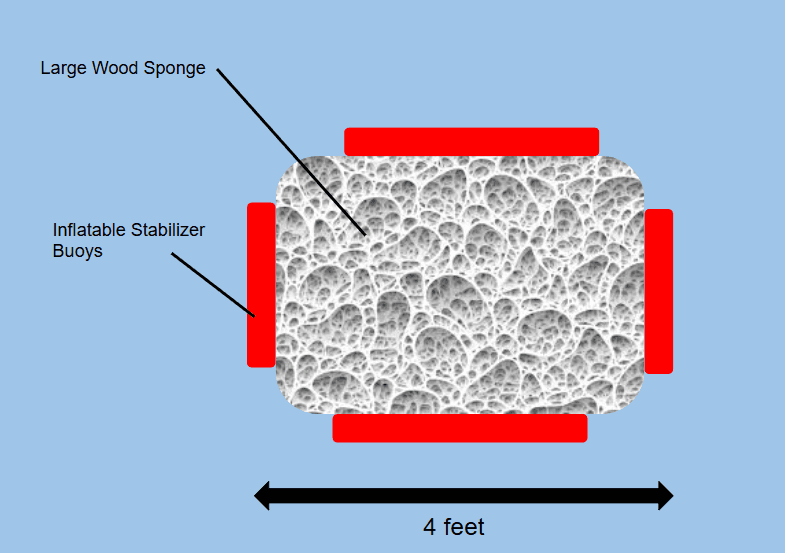
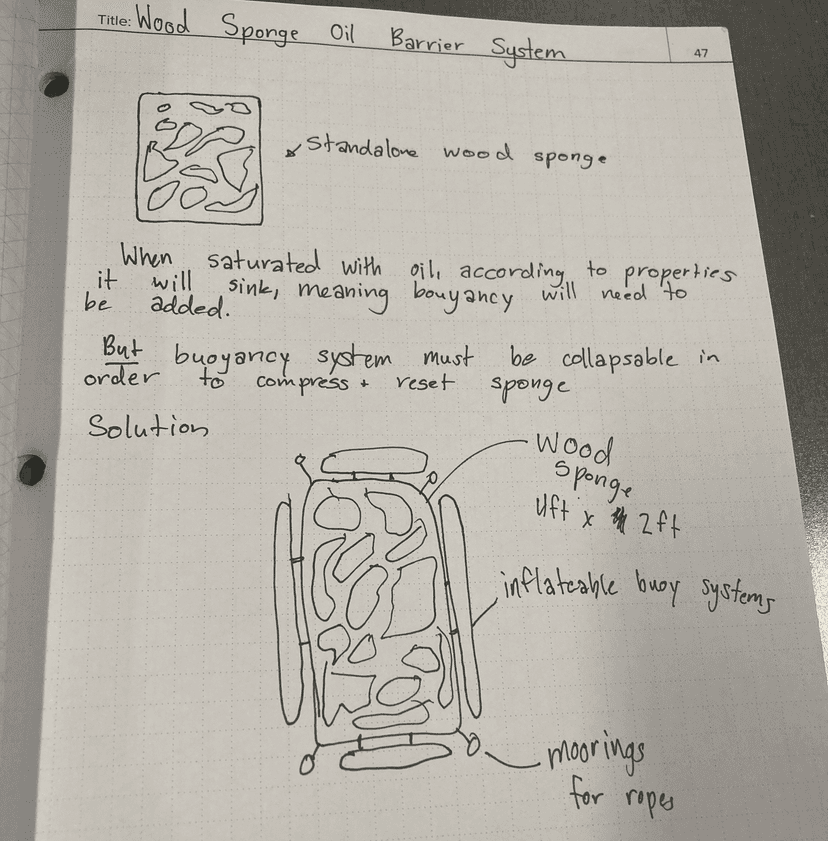
Wood sponges have been used in a variety of applications. While creating a project, I considered several, ranging from kitchen scale, automotive use, and environmental usage.The project I concluded is most promising is using wood sponges in the creation of a floating oil barrier. This barrier can be deployed in the event of an oil spill to contain and absorb the oil, preventing it from spreading and causing further damage. The sponge will have floating buoyancy systems that prevent it from sinking. Once the sponge has reached saturation, it can be removed from the water, the bouyancy system deflated, and sponge squeezed out. Due to the sponges flexible properties, once the oil is absorbed, the barrier can be easily removed and the barrier rolled up to squeeze out oil for reuse.
Test Plans
Although some tests have been conducted, more research is needed to fully understand the potential of wood sponges and their mechanic properties. Explore the Gantt Chart illustrating a test plan, as well as the current known properties. The wood sponge has similar propertties to the original wood blocks, but is far less dense, more hydrophobic, and lighter overall. More details are available below.
Reversible compression rate of 40%, Water contact angle was up to 138°, and the oil absorption capacity was 25 g·g –1, Low density: (0.47 ± 0.007 g cm –3 ), 60% compressive strain

3D Model
Explore the structure of a wood sponge to understand its porosity and surface treatment, which contribute to its effectiveness in oil absorption.
Reflection
I feel like I went above and beyond my learning targets and self assigned goals. I was able to create drawings, explore the material, and plan out tests. I was also proud of the way I showcased the material and provided background information. For example, when I discuss the properties of oil and water, I was proud of the simulation and info I provided. Undoubtedly, the most difficult part of the assignment was the 3D modeling due to technical difficulties. (Fusion did not work for me on any of the 6 computers I tried). If I had more time or resources I would like to pursue the 3D modeling further.
References
Cai, Yijing, et al. “Wood Sponge Reinforced with Polyvinyl Alcohol for Sustainable Oil–Water Separation.” ACS Omega, vol. 6, no. 19, 10 May 2021, pp. 12866–12876, https://doi.org/10.1021/acsomega.1c01280. Accessed 5 Apr. 2022.
Guan, Hao, et al. “Highly Compressible Wood Sponges with a Spring-like Lamellar Structure as Effective and Reusable Oil Absorbents.” ACS Nano, vol. 12, no. 10, Oct. 2018, pp. 10365–10373, https://doi.org/10.1021/acsnano.8b05763.
“Wood Sponge Soaks up Oil from Water (Video).” American Chemical Society,www.acs.org/pressroom/presspacs/2018/acs-presspac-october-24-2018/wood-sponge-soaks-up-oil-from-water-video.html.
“Wood-Based Sponges Could Clean Oil Spills.” Nomaco, 1 Feb. 2019,www.nomaco.com/wood-based-sponges-could-clean-oil-spills/.